What Is a Blockchain? Stunning, Effortless Guide.
Article Structure
A blockchain is a shared database that stores records in linked blocks and secures them with cryptography so no one can change history without group approval.
That line carries a lot of weight. It covers who holds the data, how blocks connect, and why entries resist tampering.
How the structure works
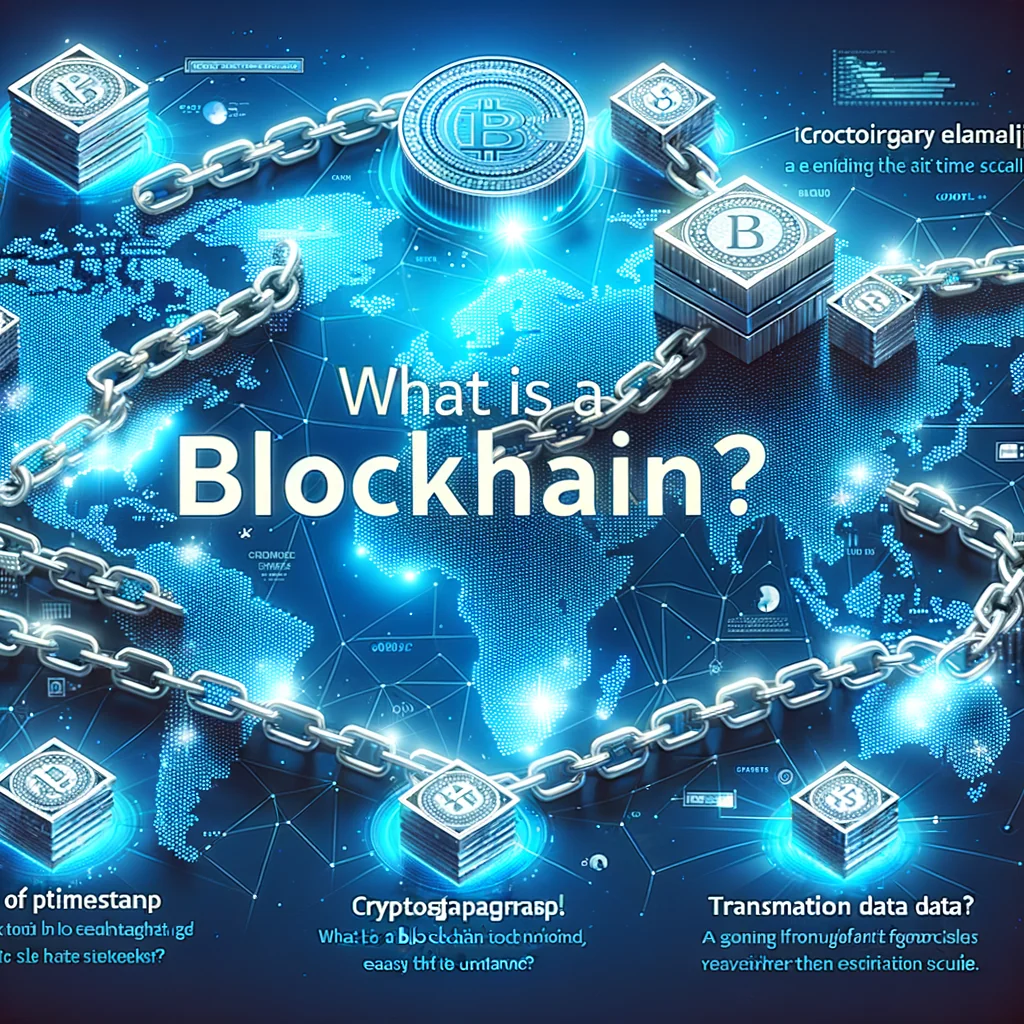
Think of a long chain of boxes. Each box holds a batch of records, a timestamp, and a special fingerprint called a hash. It also stores the hash of the previous box. This creates a tight link.
If a bad actor edits one record, its box hash changes. The link breaks. Nodes see the mismatch at once and reject the altered copy.
Core parts you should know
Four pieces make the system tick. They show up in most networks, even if details differ by design.
- Blocks: Batches of validated transactions with a hash and timestamp.
- Nodes: Computers that hold the ledger and share updates with peers.
- Consensus: Rules that let nodes agree on the next block.
- Cryptography: Keys and signatures that prove who made a change.
These parts give the ledger a clear flow. Data enters, gets checked, and settles into a block that links to the one before it.
A tiny scenario
Alice sends Bob 0.5 coin. Alice signs the transaction with her private key. Nodes see the signed message and verify the signature using her public key. The transaction moves to a pool of pending items and waits to be added.
Once it lands in a block and gets enough confirmations, Bob can treat the funds as final. The record sits there for good.
From click to block: the path of a transaction
Here is the typical flow from the moment you hit send to the moment the network locks your change into the ledger.
- Create: A wallet forms a transaction and signs it with a private key.
- Broadcast: The signed transaction goes to nearby nodes.
- Validation: Nodes check the signature and balance rules.
- Selection: A validator or miner picks it for a new block.
- Consensus: The network agrees the block is valid under its rules.
- Finality: The block joins the chain and gains confirmations.
Different chains change the details, but this order holds in broad strokes. The goal is the same: make sure valid entries move forward and bad ones stop.
Why the hash link matters
A hash is a one-way function that turns data into a fixed string. A tiny edit in the input produces a very different output. Blocks chain those outputs together.
This design makes retroactive edits stand out. You cannot quietly rewrite a record. You would need to rebuild that block and every block after it, under live network scrutiny.
Proof of Work vs Proof of Stake
Networks use different methods to choose who adds the next block. The choice affects speed, cost, and energy use.
| Method | How it selects | Security idea | Trade-offs |
|---|---|---|---|
| Proof of Work | Miners solve a hard puzzle | Attacks need huge compute | Energy heavy; steady finality |
| Proof of Stake | Validators lock stake | Attacks risk losing stake | Lower energy; varies by design |
Both guard the chain by raising the cost of cheating. One burns energy, the other puts funds at risk. Each path has many variants that tune performance and security.
Public, private, and consortium chains
Not all blockchains run in the open. Some restrict who can write or read. The choice depends on the use case and trust model.
| Type | Who can read | Who can write | Typical use |
|---|---|---|---|
| Public | Anyone | Open by rules | Crypto, open apps |
| Private | Selected users | One org | Internal audit trails |
| Consortium | Members | Several orgs | Supply chains, finance |
Public chains favor censorship resistance. Private and consortium chains favor controlled access and clear roles.
Smart contracts in plain language
A smart contract is code stored on a blockchain. It runs when users call it. The code holds rules, tracks state, and moves assets under those rules.
Think of a digital vending machine. You send a coin and a code checks the price and stock. If all checks pass, the code delivers the item. If not, it rejects the call.
What blockchains do well
They shine where many parties need a shared, tamper evident log. The log must stay accurate with no central boss.
- Digital cash and tokens with clear ownership.
- Settlement across borders without a single gatekeeper.
- Audit trails for assets, like parts or art.
- Programmable trades and escrow with smart contracts.
Each point ties back to the core: a single source of truth across many nodes. The chain keeps everyone on the same page.
Limits and common myths
Blockchains are not fast databases for every job. Public chains handle fewer transactions per second than big cloud systems. Fees can rise in busy periods.
Data on a chain is permanent by design. That helps audit. It also means poor inputs last. Good data entry and off-chain checks still matter.
Privacy on a public ledger
Public chains are transparent. Addresses are pseudonyms, not names, but flows are visible. Firms can link addresses to people through patterns, leaks, and on-ramps.
Tools exist to raise privacy, such as zero-knowledge proofs and mixers. They add costs and risks. Use them with care and within the law.
Speed, scaling, and layers
To scale, many projects add layers. A base layer keeps security and finality. A second layer handles volume with smaller, faster proofs or bundles.
Examples include payment channels and rollups. They push most work off-chain and post proofs back on-chain. That balance keeps speed and safety in check.
Security basics for users
Keys control assets. Lose the private key and access is gone. Share it and funds are at risk. Wallets help, but habits matter more.
Here is a short set of steps that raise your safety without fuss.
- Write seed phrases on paper and store them offline.
- Use hardware wallets for large amounts.
- Verify addresses with a test send first.
- Check contract addresses from trusted sources.
- Keep devices updated and use phishing filters.
These moves block common threats. They are simple, repeatable, and cheap.
How to judge a blockchain project
Projects vary in goals and quality. A quick review saves time and money. Focus on facts you can check.
- Whitepaper clarity: Does it state the problem and the method?
- Open code: Is the repo active and reviewed?
- Token use: Does the token have clear utility?
- Validator set: How many, how diverse, how honest incentives?
- Security track record: Audits, bug bounties, incident reports.
A short pass over these points filters hype. It pushes you to evidence instead of catchy slogans.
Frequently asked, short answers
Is a blockchain a database? Yes, but it trades speed for shared trust and immutability. It suits records that many parties must trust without a central owner.
Can someone edit a block? Not without detection and heavy cost. The link of hashes and consensus rules make quiet edits impractical.
Are crypto and blockchain the same? Crypto uses blockchains, but a chain can run without a currency in private settings.
Final thought
At its core, a blockchain offers a shared history that people can verify without a central gate. That simple promise enables money, markets, and logs that stand up to scrutiny. Use it where shared trust and clear audit are worth more than raw speed.